Types of Pakistani Dresses for Women: Names, Styles and Occasions
Nearly every Pakistani outfit that women and girls wear is built from three pieces: a top, a bottom, and a dupatta. The top might be a kameez, kurta, frock, or choli, and the bottom a shalwar, gharara, sharara, or lehenga skirt. Swap one piece, and you get a different dress, which is why traditional Pakistani clothing has so many names.
Below are 14 common types of Pakistani dresses, how to tell the lookalikes apart, and what to wear each one to, from everyday errands to Eid, mehndi, baraat, and walima.
It helps to know them. Walk into any shaadi, and you'll spot a dozen ethnic outfits that look alike, but a kameez isn't a kurta, a gharara isn't a sharara, and not every long frock is a peshwas. The table below lists the different types of Pakistani dresses at a glance, and for what's trending this season, see our guide to women's fashion trends in Pakistan.
Pakistani dress names at a glance
| Dress | What it is | Best for |
|---|---|---|
| Kameez | Long tunic, knee-length or longer | Daily wear, work, formal |
| Kurta | A shorter, plainer tunic, around hip or mid-thigh | Casual days, uni, running errands |
| Angrakha | Wrap top that crosses over and ties at the side | Eid, festive dinners |
| Shalwar | Loose, pleated at the waist, narrow at the ankle | Daily wear, traditional looks |
| Churidar | Slim trousers that bunch up at the ankle | Under frocks and anarkalis |
| Palazzo | Wide, straight-leg trousers | Eid, casual formals |
| Gharara | Trousers fitted to the knee, then flared | Nikkah, baraat |
| Sharara | Trousers that flare from the waist | Mehndi, dholki, Eid |
| Peshwas | Floor-length frock with a fitted bodice and full skirt | Formal dinners, walima |
| Anarkali | Fitted, flared frock of any length | Festive, formal |
| Kalidar | Frock made of many flared panels (kalis) | Festive, wedding functions |
| Lehenga | Full skirt worn with a short choli | Baraat, mehndi, walima |
| Maxi | One-piece floor-length gown, often with a trailing hem | Walima, receptions |
| Dupatta | The long scarf that goes with nearly everything | Every look |
Shalwar Kameez and Kurta: The Base of Traditional Pakistani Clothing
The shalwar kameez is Pakistan's national dress. Of the two pieces, the kameez is the garment Pakistani fashion loves to play with: side slits climb, sleeves go bell-shaped for a year, hems drop to the ankle and then come back up. Still, it's always a long tunic over shalwar or pants.

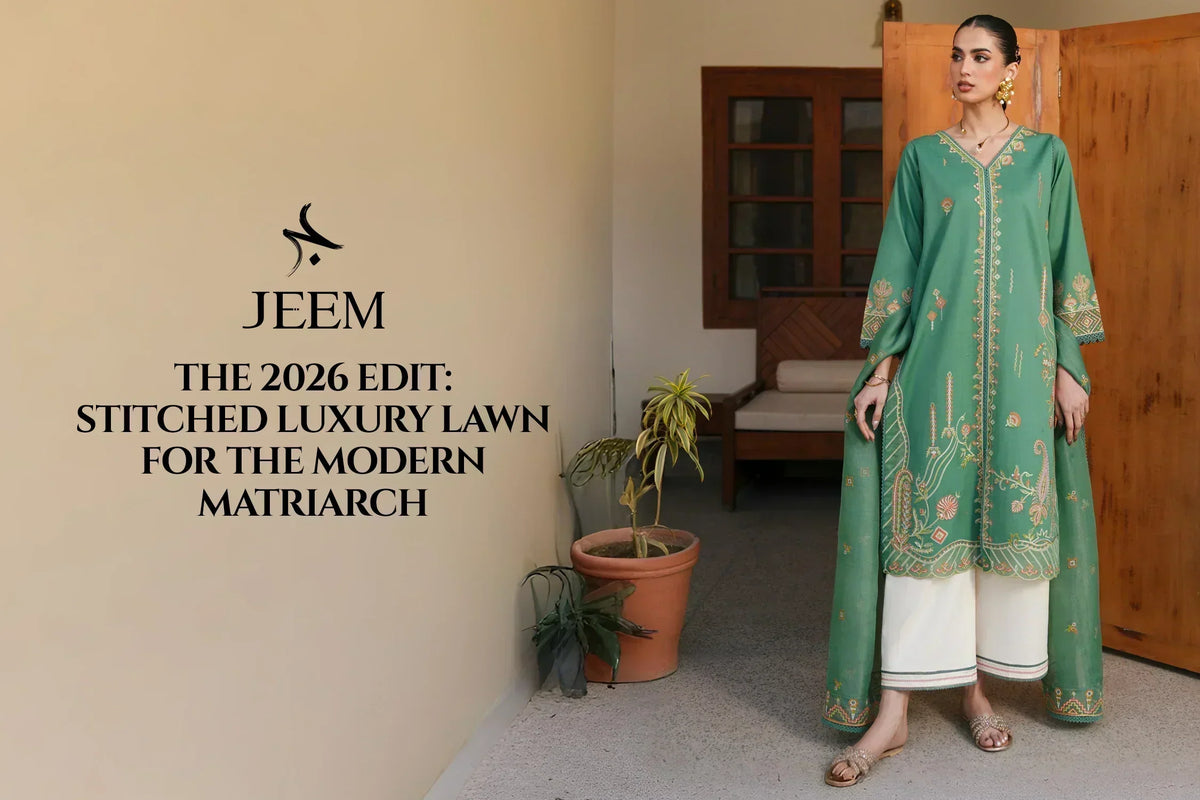
Amber White: an embroidered lawn three-piece from JEEM's stitched lawn collection.
In summer, most of us live in printed or lightly embroidered lawn dresses. JEEM's stitched lawn collection shows how much one silhouette can change with print, neckline, and length.
Straight, A-line and Angrakha Kameez Cuts
The cut is the easiest way to tell types of kameez apart:
- Straight cut: long and narrow with slits at the sides. It looks sharp, makes you look taller, and works well at the office.
- A-line: snug up top and flaring out a little towards the hem. Softer, more relaxed.
- Angrakha: the front panels cross over and tie at the side, so you get a V-neckline without trying. The wrap gives shape without extra embellishment, and you'll see it all over JEEM's pret dresses.
Kameez Necklines and Collars
You'll mostly see four necklines: round, V, band (or Chinese) collar, and boat neck. A band collar looks tidy for work. For evenings, a V-neck or an angrakha overlap feels softer.
Got a heavily embroidered front already? Pick a plain round neck. Two busy areas right next to each other just look cluttered.
Kurta vs Kameez: What's the Difference?
Length, mainly. A kurta is shorter, ending somewhere between the hip and mid-thigh, and it's usually plainer. A kameez hangs lower, can be dressed up for dinner, and you'll usually buy it as a two-piece or three-piece suit.
Kurtas are what college girls pull on with jeans or cigarette pants when they can't be bothered. Ask anyone here to picture a "Pakistani suit" though, and they'll see a kameez, matching shalwar and a dupatta. Once the top's sorted, the bottom does the rest.
Shalwar, Churidar and Other Pakistani Trouser Styles
Change what's underneath and the same kameez can go from a college day to a dawat. Here are the bottoms you'll see most.
Shalwar and Tulip Shalwar
A shalwar ties with a drawstring (azarband) that bunches the waist into pleats, then tapers down to a cuffed ankle. It's the go-to for traditional Pakistani attire.
A tulip shalwar is the newer version, with panels that overlap at the ankle like petals. It looks best with shorter shirts.
Straight Trousers, Palazzo and Churidar
- Straight trousers: slim and clean, they work with long straight shirts and office wear.
- Palazzo: wide, straight-leg pants that pair well with a long kameez for Eid and casual formals.
- Churidar: slim bottoms cut extra long so the fabric gathers in folds at the ankle. They are the usual choice under frocks, anarkalis, and peshwas.
Two celebration bottoms cause more confusion than all the others combined.
Gharara vs Sharara: How to Tell Them Apart
These are the two most mixed-up Pakistani dress names. Both are wide, flowing bottoms for celebrations, but they flare from different points.
| Gharara | Sharara | |
|---|---|---|
| Where the flare starts | At the knee | At the waist or hip |
| The knee | A visible joint, often covered with gota or embroidery | No joint, one smooth flare |
| Overall feel | Structured, regal, traditional | Fluid, lighter, more modern |
| Ease of movement | Heavier flare, slower to move in | Easier to walk and dance in |
| Occasions | Nikkah, baraat, formal weddings | Mehndi, dholki, Eid |
What Is a Gharara?
A gharara is fitted from the waist to the knee, where a joined band turns it into a full flare. The knee joint is usually covered with gota or embroidery, which is the quickest way to spot one.
The garment began in Awadh during the Nawab era and remains a favourite for Pakistani weddings. A farshi gharara has legs so long they trail along the floor, since "farshi" means "of the floor". Wear a gharara with a short kameez so the embroidered knee stays visible.
What Is a Sharara Suit?
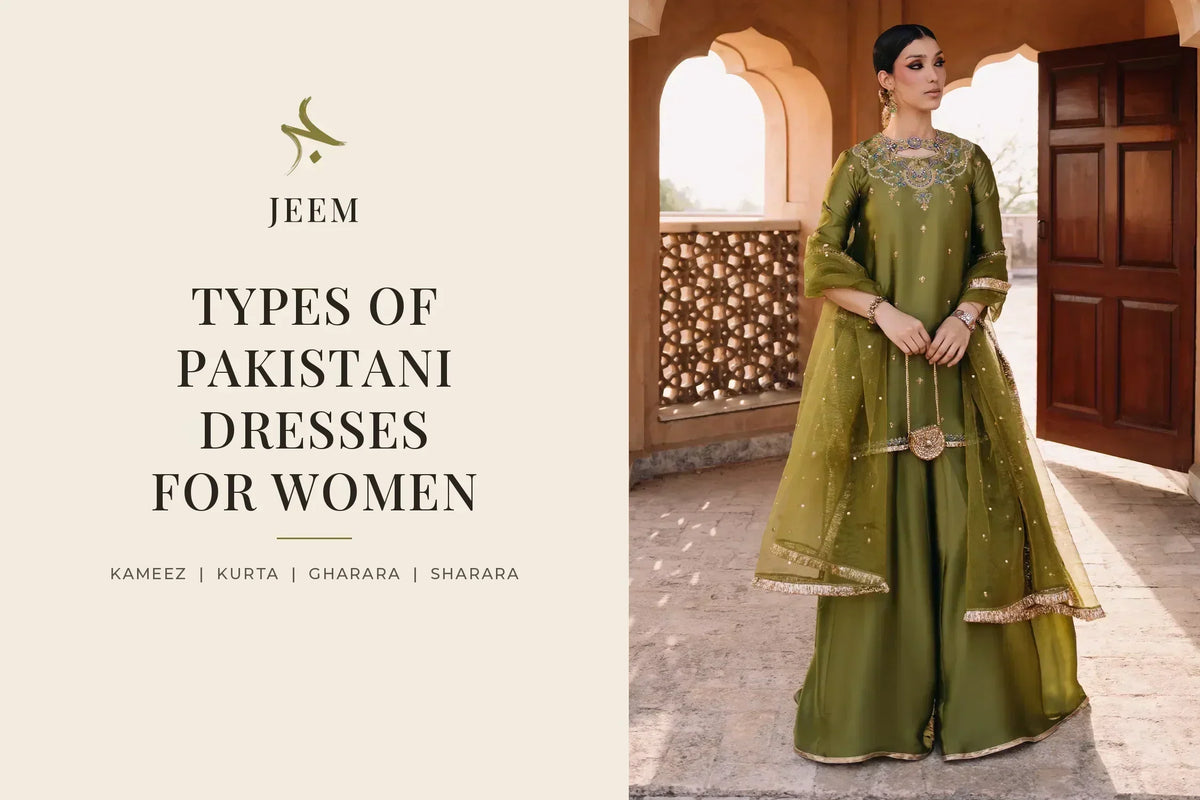
A sharara flares from the waist or hip in one smooth line, with no knee seam. So it's lighter and much easier to dance in. No wonder it shows up at every mehndi and dholki.
Keep the top short a frock or straight shirt that stops above the knee. A longer shirt hides the flare, and the sharara starts to look like ordinary wide pants. If you prefer one long flowing piece instead, frocks are the next place to look.
Peshwas, Anarkali and Kalidar: Long Pakistani Frocks
What Is a Peshwas?
A peshwas (you'll also see pishwas) is a long frock: snug through the bodice, then a skirt with serious volume that falls to the ankle or the floor. It goes back to the Mughal and Nawab courts, where women wore it in fine muslin.
These days it's a favourite for formal dinners and walima receptions. Pair it with churidar or straight pants and a dupatta.
Peshwas vs Anarkali
The two are close relatives, and many see the peshwas as the anarkali's ancestor. In Pakistani use, a peshwas is usually longer and more formal, often with heavy embroidery on the bodice and an inner layer.
An anarkali is any flared frock that hugs the bodice, and it can be knee-length or longer.
What Is a Kalidar?
A kalidar is made of lots of flared panels, called kalis, stitched side by side so the hem spreads into a wide circle. More panels mean more flare. JEEM's Amaltaas '26 festive edit includes kalidar styles alongside lehengas for wedding functions.
Lehenga and Maxi: Pakistani Wedding Attire for Brides and Guests
For wedding attire, brides and guests in Pakistan mostly end up choosing between two things: a lehenga or a maxi.
What Is a Lehenga?
Think of a lehenga as a long skirt with a lot of fabric in it. On top goes a short choli, or a longer shirt if you want more cover, and a dupatta over that. For the baraat, tradition says heavy and red, or a deep jewel tone. Lighter lehengas are better for mehndi and walima.
For the wedding day itself, browse JEEM's bridal dresses.
What Is a Maxi?
A maxi is a single floor-length gown, shaped at the bodice, and the back of the hem often trails a little. Walima is where you see them most, usually in pastels or ivory. Lighter ones are lovely for formal dinners too.
Lehenga vs maxi
| Lehenga | Maxi | |
|---|---|---|
| Pieces | Skirt, choli or shirt, dupatta | One-piece gown, often with a dupatta |
| Movement | Easier to adjust and dance in | Smooth line, heavier trailing hem |
| Occasions | Baraat, mehndi | Walima, receptions |
| Feel | Traditional and colourful | Soft and elegant |
Whatever you choose, the dupatta finishes the look.
Dupatta Fabrics and When to Wear Each
Almost every outfit here comes with a dupatta, and the fabric changes more than you'd expect. Our rule is simple. Match the dupatta to the event, and if the shirt is heavily worked, keep the dupatta light.
Everyday and Festive Dupattas: Lawn, Cotton and Chiffon
- Lawn and cotton: light, airy, and easy for hot days.
- Chiffon: soft and floaty, great for festive and semi-formal looks.
Formal Dupattas: Organza, Silk, Net and Velvet
- Organza: a bit stiff, with a soft shine, and embroidery sits on it nicely.
- Silk: heavier and richer, meant for formal events.
- Net: fine and light, used most in bridal and wedding wear.
- Velvet and shawls: warm and weighty for winter weddings, as in JEEM's velvet dresses.
Pret vs Unstitched: How Pakistani Fashion Is Sold
Shopping for Pakistani ladies' suits? You'll usually be picking between two formats.
Pret (Ready-to-Wear)
Pret is fully stitched and ready to wear. It saves time and gives you the exact cut the designer intended, as with JEEM's luxury pret.
Unstitched Suits
Unstitched suits come as fabric, usually a shirt piece, a trouser piece, and a dupatta, and your tailor does the rest. It takes longer, but you decide the fit and the style.
Not sure whether an event calls for luxury pret or formal wear? Our luxury pret vs formal wear guide helps you decide by occasion.
Which Pakistani Dress to Wear for Each Occasion
Everyday and Office
- Everyday: a lawn kameez with shalwar or straight pants for ladies, or a short kurta with jeans for younger girls.
- Office: a straight-cut kameez with a band collar and cigarette pants.
Eid, Mehndi and Dholki
- Eid: angrakha or an embroidered kameez, palazzo underneath, chiffon dupatta.
- Mehndi and dholki: sharara and short frock. A light lehenga works too.
Nikkah, Baraat and Walima
- Nikkah and baraat: gharara with a short kameez, or a lehenga. Peshwas and churidar if you'd rather wear a frock.
- Walima and formal dinners: maxi, peshwas, or keep it simple with a silk kameez and one statement dupatta.
Once you can tell a kurta from a kameez at a glance, and a gharara from a sharara, shopping gets a lot easier. Start with the top, then build the bottom and dupatta around it. Our new arrivals are a good place to start, for everyday pieces and wedding ones.
For more outfit ideas by event, see our guide on how to style Pakistani women's clothing for every occasion.
Frequently Asked Questions
What Is the National Dress of Pakistan?
It's the shalwar kameez (also spelled salwar kameez), worn by men and women all over the country. Pakistani women tend to wear it as a three-piece: kameez, shalwar or trousers, and a dupatta. Lawn and cotton are for daily wear. Chiffon, silk, and organza come out for formal events.
What Is the Difference Between a Lehenga and a Gharara?
Simple: a lehenga is a skirt, and a gharara is trousers. The gharara stays slim down to the knee, then flares, and you can see the embroidered joint right at the knee. A lehenga has no leg division at all. Both are worn at Pakistani weddings, the baraat more than any other day.
What Do Pakistani Brides Wear for Mehndi, Baraat and Walima?
Usually three different looks. Mehndi is the colourful one: think bright yellow, green, or orange in a sharara or a light lehenga. The baraat outfit is traditionally red and heavy, a lehenga or gharara. By the walima, most brides go softer: a maxi or lehenga in pastel, ivory, or silver.
What Is the Difference Between a Kurta and a Kurti?
A kurti is the shorter, slimmer cousin of the kurta and usually ends at the hip. It's the uni and weekend option, worn with jeans, pants, or leggings. The kurta sits a bit lower and looser. A kameez is longer again, and dressier than both.
What Do 2 Piece and 3 Piece Mean in Pakistani Suits?
A 2-piece means you get a shirt and trousers. A 3-piece adds a matching dupatta. Both pret and unstitched suits use these terms, so read the listing before you buy. A 1-piece is usually just the shirt, and you pair it with bottoms you already own.